By
Global Risk Insights
:
From pollution tracking apps, 'escape the smog' travel deals,
and even premium bottled air, discover the companies behind
China's anti-pollution business boom.
Much has been written about China's pollution crisis. This state
of affairs has led to myriad problems for China, as the government
seeks
 to promote
more sustainable growth
. In the midst of all this, the severity of China's pollution
nightmare is inspiring corporate dreams, as both multinationals and
a slew of startups cash in. Even China's fashion industry is
incorporating gas masks as the haute couture accessory of the
year.
to promote
more sustainable growth
. In the midst of all this, the severity of China's pollution
nightmare is inspiring corporate dreams, as both multinationals and
a slew of startups cash in. Even China's fashion industry is
incorporating gas masks as the haute couture accessory of the
year.
(click to enlarge)
This boom has already produced China's first green-tech
billionaires: Zhang Kaiyuan, chairman of Beijing SPC Environmental
Protection Tech. Co., and Ao Xiaoqiang, chairman of Beijing SDL
Technology Co. Both companies have seen their stocks jump by more
than 180% over the last two years.
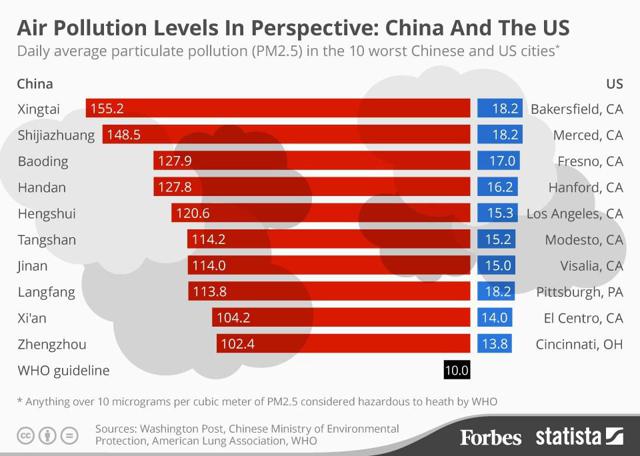
China is home to many of the world's most polluted cities,
notably Beijing where "Chinese scientists have warned that toxic
air pollution is now so bad that it
resembles a nuclear winter
." Pollution is one of the leading causes of public discontent in
China. Consequently, the government takes the issue very seriously,
as domestic stability is its paramount concern.
Pollution forecasting a major growth industry
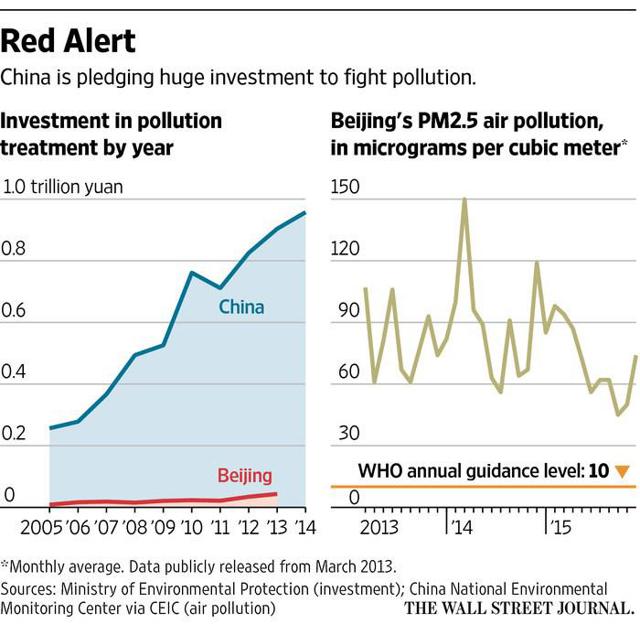
One area that the Chinese government is investing in is
pollution forecasting. To this end, both IBM (
IBM
) and Microsoft (
MSFT
) have signed contracts in the fast growing market of air quality
forecasting. Using emerging cognitive computing technologies
developed in its China-based research labs, IBM secured its first
government contracts in 2014. Specifically, IBM launched the Joint
Environmental Innovation Centre in conjunction with the Beijing
Environment Protection Bureau in December 2015.
(click to enlarge)
IBM has also partnered with the city of Zhangjiakou - the
co-host for the 2022 Winter Olympics - to do air quality modeling
and planning ahead of the games. Similarly, Microsoft has signed up
the Chinese environment ministry as a client, and is promoting
Urban Air, its air quality app which provides pollution predictions
48 hours in advance (current government sites only provide 24 hour
notice).
Microsoft is already facing competition fromChinese startups
such as Beijing-based Air Visual; a crowd sourced pollution
monitoring start-up which provides three day predictions via its
website and app. These apps join others, such as the China Air
Quality Index (originally DirtyBeijing) created by Fresh Ideas,
anotherBeijing based start-up in 2011. Co-founders Zhang Bin and
Wang Jun came up with the idea while working at Baidu - China's top
search engine. Zhang recalls that:
It was mid-October 2011, and the air quality in Beijing was
quiet bad, as you may imagine. It came to my mind that if could
check the air quality on our smart phones and receive pollution
notifications that would be quiet helpful and handy.
Fresh Ideas has since grown into a promising venture, with its
app (pictured) - available for iOS and Android - having been
downloaded five million times and sporting 300,000 daily active
users. This success has not come without its own problems, forcing
Zhang and Wang to keep a low profile.
(click to enlarge)
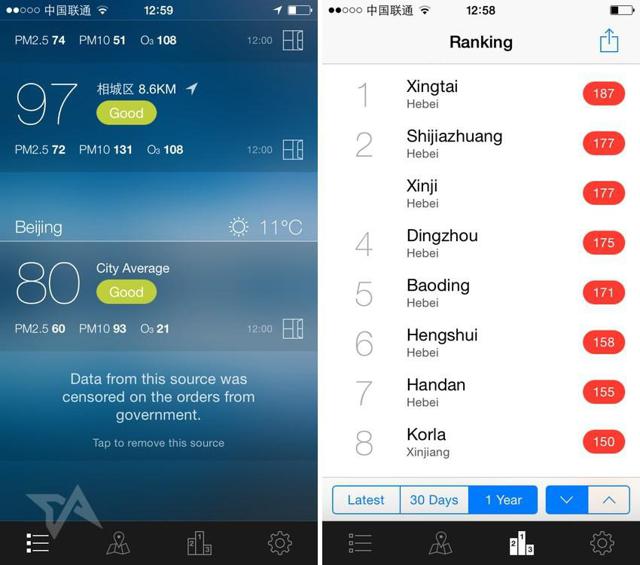
The initial company name angered the government, as did their
inclusion of air quality readings from the U.S embassy in Beijing.
The American data is considered more accurate, and often showed
glaring disparities in comparison to China's official pollution
readings: the government has since censored the U.S readings.
Escaping the smog
Fresh Ideas is not the only company taking advantage of the
country's pollution problem to run afoul of the Chinese government.
In March 2014, Chinese regulators ordered the country's two largest
insurers to stop selling
smog insurance
. People's Insurance Company of China ((PICC)) had offered Beijing
residents 1,500 yuan ($240) payouts if they were hospitalized due
to smog. Similarly, Ping An Insurance Group offered travelers a
daily 50 yuan compensation if they visited a smoggy city for more
than two days.
Ping An even partnered with Ctrip (
CTRP
), a Chinese travel agency to promote "clean air getaways." Despite
the government axing the aforementioned insurance plans, Ctrip has
continued its own promotional deals. The company reported that its
December
"smog escape routes" promotion
did very well, as 60% of Chinese cities experienced high pollution
levels during the holiday season.
Ctrip spokesperson Yan Yin explains the interplay between
pollution levels and travel industry trends in China, as "searches
on our app and website rise in pace with smog levels. Many
customers moved their departure dates forward or switched from
domestic to international destinations to escape the severe air
pollution."
Pollution crisis spurs 'green' business boom
There has been pollution driven gold-rush in China in recent
years, as pollution awareness enters popular culture. One of the
most popular films in China in 2015 was
Under the Dome
: an independent pollution documentary released online which
garnered more than 100 million views in 48 hours.
Lia Shensheng, a Shanghai based environment analyst with Capital
Securities Corp, has noticed the momentum - "the influx of capital
is especially strong this year because of the huge reaction brought
by the documentary."
Pollution driven consumption trends
have also been confirmed by Taobao, China's Ebay (
EBAY
). In December 2013, during extreme pollution levels, Taobao saw a
week on week increase of 267.5% in air purifier sales, up 1264.4%
from a year before. Similarly, sales for face masks saw a weekly
jump of 173%. Air purifiers can cost Chinese consumers the
equivalent of hundreds, even thousands of dollars, with foreign
brands such as Siemens, Philips, and Daikin the top sellers.
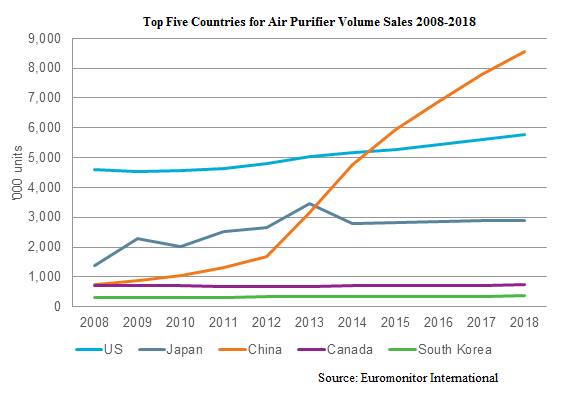
This demand only grew in 2015, drawing new players, such as
Texas-based start-up Oransi, which is selling $2000 dollar boutique
air purifiers to China's growing HNWI market. Many Chinese view air
purifiers as healthy living purchases, a fact that many companies
are cashing in on, despite the fact that the FDA does not regulate
air purifiers, as it currently does not consider them medical
devices.
On the other end of the price spectrum, local businesses across
China are also cashing in on consumer concerns about air pollution.
For instance, in Zhengzhan, several botanical stores have turned a
tidy profit selling plants that allegedly filter out hazardous
PM2.5 particles. In a similar vein, a restaurant in Zhangjiagang
installed an air purification system and has added a clean air
surcharge to its prices.
Ultimately, the success of one company perfectly embodies the
wild west which is China's anti-pollution market. Vitality Air is a
Canadian
start-up which sells well, air
. The company - which touts its products as "your solution to
pollution" - bottles pure mountain air from Banff and Lake Louise
in Canada, selling it at $28 per bottle. Two months ago the company
started shipping its products to China, and has met with startling
success. Harrison Wong, the company's China spokesperson recalls
that the minute the bottles went on sale on Taobao, they sold out
almost instantly.
Many have written of the economic costs of pollution in China,
yet for the bottom line of some companies, the outlook is anything
but gloomy.
See also
A European Biotech Stock Basket For 2016
on seekingalpha.com